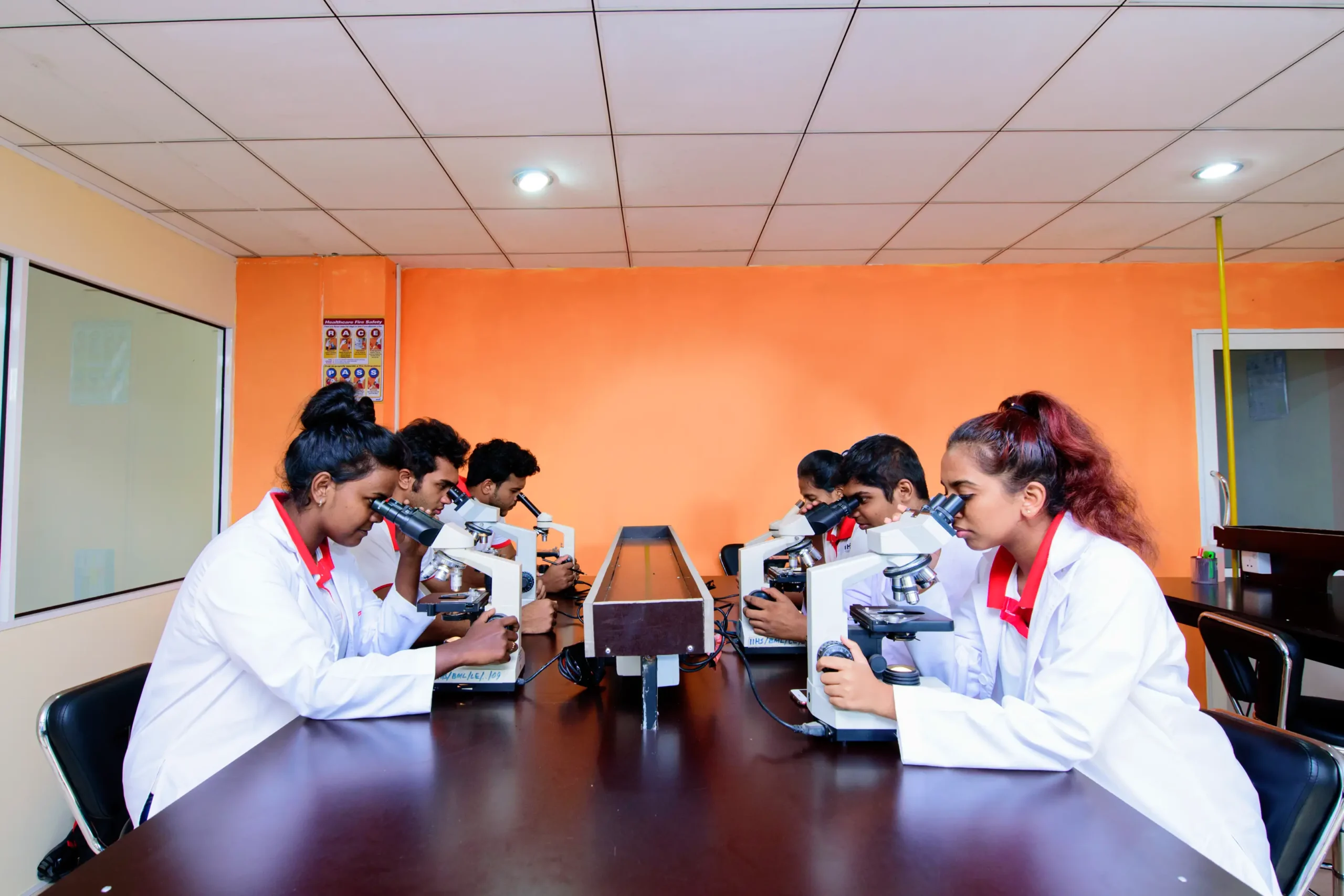
Doing Biomedical Science at IIHS, students do not just study science. They learn to think
At a time when more young people are beginning to question whether a university degree is really worth it, that concern deserves to be taken seriously. Around the world, higher education is increasingly being judged not simply by the certificate it awards, but by whether it helps students think clearly, solve real problems, communicate well, and adapt to a changing future. Recent Gallup-Lumina findings from the United States reflect this wider debate clearly. Public confidence in higher education has weakened over concerns about cost and job relevance, even while most current students still say their degree is teaching them useful, career-relevant skills. (Lumina Foundation)
In that sense, the problem is not that degrees have no value. The problem is that not every degree experience creates value in the same way. A university education becomes meaningful when it goes beyond memorization and passive learning, and instead teaches students how to question, analyse, test ideas, engage with evidence, and apply knowledge to the world around them. That is the kind of education that remains valuable, even in a future shaped by uncertainty, automation, and artificial intelligence. The World Economic Forum’s Future of Jobs Report 2025 identifies analytical thinking as the top core skill employers want, while OECD work shows that critical thinking is linked to future educational success, career development, and labour-market outcomes. (World Economic Forum)
This is exactly why the recent success of IIHS students and staff in publishing their work in Access Microbiology matters so much. The study, “Significant gaps in practise present despite higher level of public awareness in Antibiotic Use and Antimicrobial Resistance in the western province of Sri Lanka,” by IIHS student authors Hiranya Anthony, Anne Sithuvili, Dinudya Hettige, together with Ms. Dinushi Tennakoon, Ms. Lakshika Lagoshan and Mr. Gayan Danushka Gunatilake, has been accepted by the journal and it gives us much needed insight into the laymans perpective on Antibiotics and updates while giving the students exposure to a real peer-reviewed publication pipeline, which is essential for a career in Life Sciences.
This achievement is important not only because it is peer-reviewed, but because of what it represents. Undergraduate students in Sri Lanka are often underestimated when it comes to research. Yet this project shows what becomes possible when students are trained not just to repeat information, but to investigate a real public-health issue, collect evidence, interpret findings, and communicate their work to an international academic audience. The study surveyed 200 adults in Sri Lanka’s Western Province and found that although many respondents had a reasonable basic understanding of antibiotic use, major gaps in correct practice remained. While 83% knew antibiotics work against bacterial infections, 65.5% reported stopping antibiotics once they felt better, and only 60.5% recognized the term antimicrobial resistance.
That gap between awareness and behaviour is exactly why this work matters in Sri Lanka. The country has a National Strategic Plan for Combating Antimicrobial Resistance for 2023–2028, showing that AMR is already recognized as a serious national priority. Yet Sri Lankan research has also shown that antibiotics continue to be dispensed without a prescription in community pharmacies despite this being forbidden by law since 1986, with one simulated-client study finding non-prescription dispensing in 61% of pharmacies surveyed. In other words, regulation exists, but practice on the ground still shows important weaknesses. That makes local research, public engagement, and education especially important.
What makes the IIHS approach distinctive is its emphasis on active learning. Students are not only taught scientific content but are encouraged to ask meaningful questions, work with evidence, understand community health challenges, and communicate their findings effectively. Research on undergraduate education consistently shows that student involvement in research helps build independent thinking, confidence in drawing conclusions from evidence, stronger motivation to learn, and better scientific writing and communication.
The same is true for community-engaged learning. Evidence shows that when students connect classroom learning with real community needs, the benefits go beyond academic knowledge alone. Community-engaged learning has been associated with better academic outcomes, stronger social outcomes, and improved citizenship-related outcomes, while service-learning literature also points to gains in empathy, motivation, awareness of community issues, confidence, and problem-solving in real-world settings.
This is why IIHS believes in developing students as more holistic individuals. In a world where information is everywhere, but critical judgment is scarce, students need more than subject knowledge. They need to know how to think under pressure, how to work with people, how to understand the realities of the communities they serve, and how to respond intelligently to complex challenges. These qualities make graduates more future-proof, not because they are trained for only one job, but because they are prepared to keep learning, adapting, and contributing to the obstacle in front of them. Evidence from critical-thinking research argues that these are exactly the kinds of “job-proof” skills that become more important, not less, in the age of AI and automation.
Seen in that light, this publication is not just an academic success story. It is a visible example of what good higher education should look like. It shows that when students are given research exposure, critical-thinking opportunities, and meaningful engagement with real public-health concerns, they become far more than degree holders. They become problem-solvers, communicators, contributors, and professionals who are ready for a world that will demand both competence and judgment.
For IIHS, this is a proud institutional milestone. For Sri Lanka, it is a reminder that undergraduate students can contribute to serious scientific conversations when they are taught in the right way. And for students who wonder whether a degree is still worth it, this is perhaps the clearest answer: the right degree, at the right institution, still has the power to change not only a career, but the way a person thinks, serves, and responds to the world.