From Foundation to Doctorate: How IIHS Supports Your Complete Academic Journey
Most students approaching a healthcare education in Sri Lanka are thinking about the next step: the qualification they need to begin a career or progress within one. What they are less often thinking about is whether the institution they choose can support not just that step, but every step that follows it.
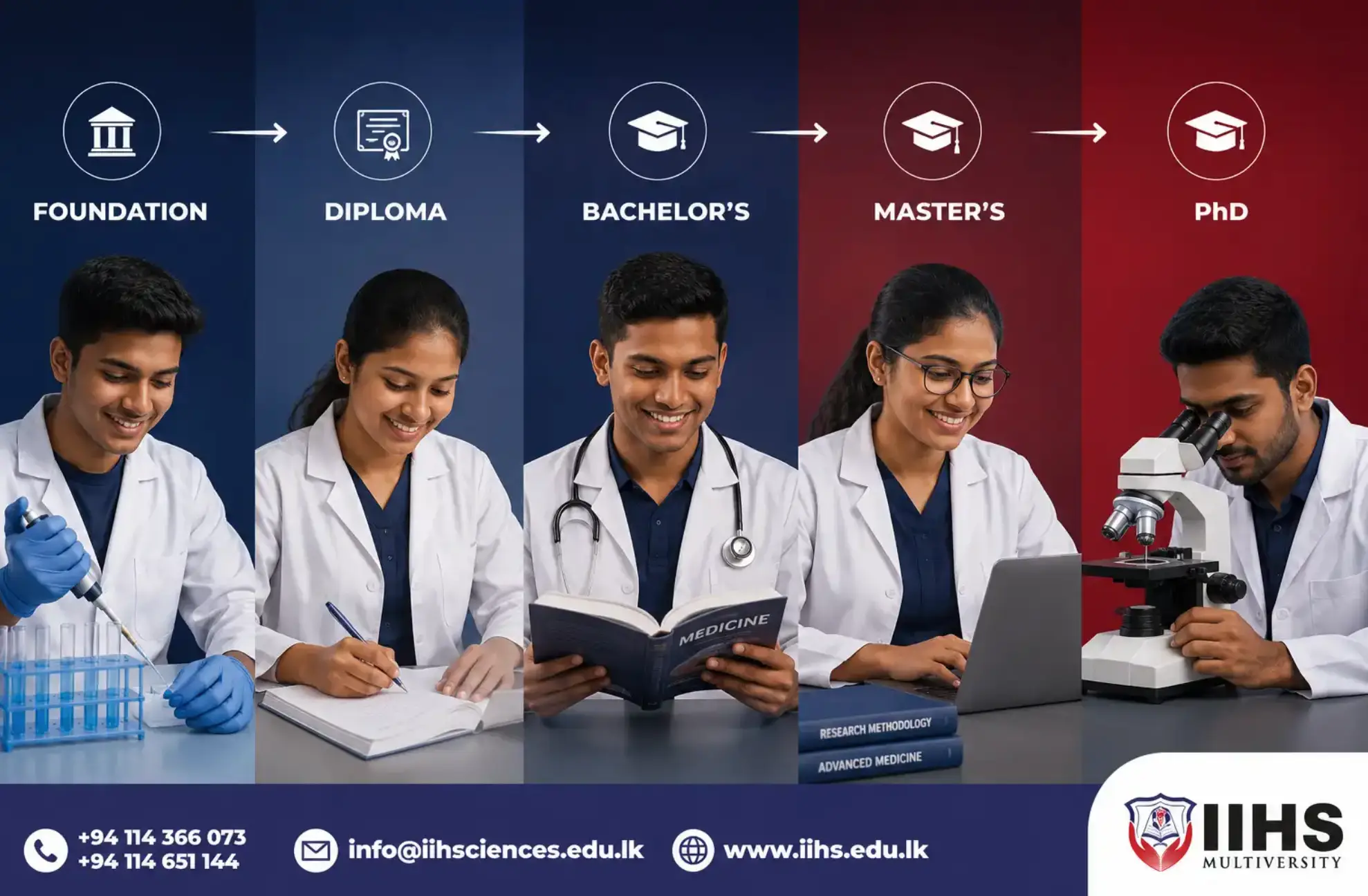
The distance from a foundation course to a doctoral qualification in healthcare is considerable. It spans years of study, multiple qualification levels, professional registration, clinical practice, and in many cases international progression. Most institutions support one or two points along that continuum. IIHS is structured to support the entire journey from the foundation courses that open the pathway to students who did not enter with advanced qualifications, through undergraduate degrees, postgraduate programmes, and up to doctoral level study including the Doctor of Nursing Sri Lanka programme.
For students and families making decisions about where to invest in a healthcare education, that continuity matters. It means the institution chosen at the beginning of the journey does not become a constraint later. It means academic records, professional relationships, and institutional standing accumulate in one place. And it means the progression from one level to the next is planned and supported rather than assembled independently at each stage.
What a Complete Healthcare Education Pathway Actually Requires
A complete healthcare education pathway in Sri Lanka, one that takes a student from first entry through to doctoral level is not simply a collection of separate programmes offered by the same institution. It is a structured academic progression in which each level prepares the student for the next, in which the qualifications earned at each stage are recognised by the next, and in which the institution's international partnerships extend across the full range of levels rather than being concentrated at one point.
This matters practically because the decisions made at the foundation level have consequences that extend well beyond the immediate qualification. The institution's international standing determines which overseas universities will accept credits for pathway progression. The curriculum delivered at undergraduate level determines how well prepared a student is for postgraduate study. The research foundation built at master's level determines the readiness for doctoral work. These connections are not incidental. They are the architecture of a well-designed academic pathway, and they are present or absent depending on how the institution has built its programme structure.
IIHS has developed its academic offering with this architecture in mind. The progression from foundation level through undergraduate, postgraduate, and doctoral study is not a collection of independently designed programmes that happen to sit under the same institutional name. It is a coherent pathway, one in which the progression between levels is deliberate, the international affiliations are consistent, and the student's academic development is supported throughout.
Foundation Courses at IIHS Where the Pathway Begins
Foundation courses at IIHS serve a specific and important function in the healthcare education pathway. They provide academic entry into the pathway for students who completed their secondary education without the specific qualifications required for direct entry into an undergraduate degree whether due to the subject combinations studied at A/L level, results that fell below direct entry thresholds, or a return to education after a period away from formal study.
The foundation programme is not a remedial offering. It is an academic bridge, one that delivers the scientific, clinical, and academic skills required to enter and succeed in an undergraduate healthcare degree. Students who complete the foundation successfully are equipped not just with the entry requirement for the next level, but with the academic habits and foundational knowledge that undergraduate study in healthcare will build on.
For families considering IIHS at this level, the relevant question is not simply whether a foundation programme is available, but whether the foundation at this institution connects to an undergraduate programme of genuine international standing. At IIHS, the foundation feeds directly into degree programmes in Sri Lanka that carry documented international affiliations meaning the investment at foundation level is the beginning of a pathway with real international reach, not a local stepping stone to an uncertain next stage.
Degree Programmes in Sri Lanka Undergraduate Healthcare Education at IIHS
The undergraduate degree programmes at IIHS represent the core of the institution's academic offering and the level at which the majority of students enter the pathway. These are the programmes through which IIHS delivers internationally affiliated healthcare degrees to Sri Lankan students combining local delivery at Sri Lankan tuition rates with the academic standards and institutional partnerships that give the qualifications their international standing.
The degree programmes available at IIHS span nursing, health sciences, physiotherapy, biomedical science, and related healthcare disciplines. Each is structured to meet the academic requirements of the relevant international university partner whether that is Deakin University in Australia, the University of Surrey in the United Kingdom, or Metropolia University of Applied Sciences in Finland as well as the professional registration standards of the regulatory bodies that govern practice in those countries.
For students completing an undergraduate degree at IIHS, the qualification earned is not solely a Sri Lankan credential. Depending on the pathway pursued, it may constitute part of an overseas degree through a credit transfer arrangement, or it may qualify the graduate for professional registration assessment with bodies such as AHPRA in Australia or the NMC in the United Kingdom. The international weight of the degree is determined by the partnerships behind it and those partnerships are the foundation of what makes an IIHS undergraduate qualification valuable in international healthcare career markets.


Postgraduate Healthcare Courses Advancing Within the Profession
Postgraduate healthcare courses represent the level at which working healthcare professionals build specialisation, develop leadership capability, and position themselves for senior clinical, administrative, or academic roles. The demand for postgraduate qualifications in healthcare has grown significantly as healthcare systems have become more complex and the expectations placed on senior practitioners have expanded.
IIHS offers postgraduate healthcare courses across a range of disciplines, delivered in partnership with internationally recognised universities. These programmes are designed for healthcare professionals who are already practicing who need postgraduate study that is academically rigorous, practically relevant, and internationally recognised, without requiring them to leave Sri Lanka to access it.
The postgraduate programmes available at IIHS include offerings at master's level across nursing, health administration, digital health, and other healthcare disciplines. These programmes are delivered through the institution's university partnerships, which means the qualification earned is not a local postgraduate certificate but a master's degree from the affiliated overseas university, with the standing and recognition that entails in professional and employment context.
For healthcare professionals in Sri Lanka who have been practicing at degree level and are considering the next step in their academic and professional development, postgraduate study at IIHS represents an option that combines international qualification standing with local delivery removing the financial and logistical barriers that have historically made postgraduate study abroad inaccessible for the majority of working professionals.